How to Disinherit a Child in Australia: What the Law Allows
General information, not legal advice.
On this page
- TL;DR
- Can you disinherit a child in Australia?
- Who can make a claim against your will
- What a court looks at
- Time limits differ by state
- A rule that changed in South Australia
- Does a no-contest clause work?
- How to record your reasons
- Choices that lower the risk of a successful claim
- When to see a lawyer
- Keep your will up to date
- Guardians for your other children
- Putting it in your will with WillBuddy
- FAQ
- Sources
- Recommended

Quick answer
You can leave a child out of your will in Australia. Nothing in the law forces you to give a child a set share. But an adult or minor child you exclude may still ask a court for a share of your estate, and the court can say yes. The best way to protect your decision is a valid, clearly written will that names the child, is signed and witnessed properly, and sits alongside a separate record of your reasons. This guide explains how that works in each state and territory, and how to set it up with WillBuddy.
This is general information, not legal advice.
TL;DR
- You can exclude a child from your will, but eligible children can apply to a court for "family provision" if they think they were left without adequate provision.
- Courts do not rewrite a will just because one child got less than another. The applicant has to show a real need or claim.
- Time limits are strict and differ by state: for example, 12 months from death in NSW, nine months from death in Queensland, and six months from the grant of probate in Victoria, WA, SA and the ACT.
- A no-contest clause is not a reliable shield. A separate, calmly worded statement of reasons is a better record.
- See a lawyer if you have a blended family, a business or trust, assets overseas, or expect a contest.
Can you disinherit a child in Australia?
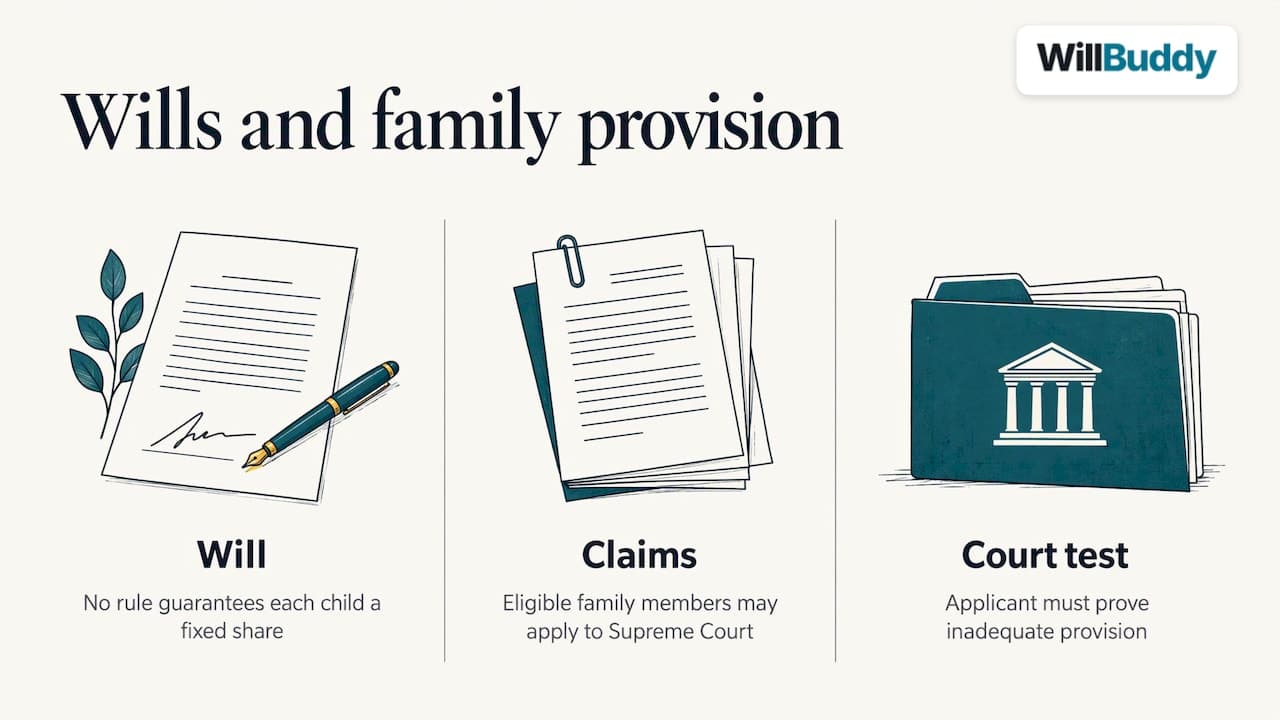
Yes, in the sense that you choose who gets what in your will. Australia has no "forced heirship" rule that guarantees each child a fixed share.
But a will is not the end of the story. Every state and territory lets certain family members apply to the Supreme Court if the will does not make adequate provision for them. This is called a family provision claim. In Victoria the same process is called testator's family maintenance.
Legal Aid WA puts the starting point plainly: the court will not interfere with a will simply because someone received less than others or thinks they should have received more. The applicant has to prove the will fails to make adequate provision for their proper maintenance, support, education or advancement in life. There is no automatic assumption that children share equally.
So the honest answer is this. You can leave a child out. Whether that holds up depends on the child's circumstances, your estate and your reasons.
Who can make a claim against your will
The list of people who can apply is set by state or territory law. Children are on every list. Others are often on it too.
- NSW: eligible people include a spouse, de facto partner, child (including adopted), former spouse, a dependent grandchild or household member, and a person in a close personal relationship.
- Victoria: a child (including an adopted child), a stepchild, or someone the deceased treated as their own child can apply. Separate criteria cover those under 18, full-time students aged 18 to 25 and those with a disability. Other adult children can still apply, but the court looks at how far they can support themselves (Administration and Probate Act 1958 (Vic) ss 90 and 91).
- Queensland: under part 4 of the Succession Act 1981 (Qld), a child, including an adopted child, can apply, and a stepchild in some situations.
- South Australia: under the Succession Act 2023 (SA), children, some stepchildren, grandchildren, parents and siblings can apply, along with partners and some former partners.
- Western Australia: the Family Provision Act 1972 (WA) lets partners, children, some stepchildren and grandchildren, and parents apply.
- Tasmania: children, including adopted children and stepchildren, are among those who may have a claim if left out.
- ACT and Northern Territory: under the Family Provision Act 1969 (ACT) and the Family Provision Act 1970 (NT), children can apply, along with partners and, in some situations, stepchildren, grandchildren and parents.
In practice, this means an adult child you exclude is usually able to apply. Whether they succeed is a separate question.
What a court looks at
A court does not simply ask whether the child is your child. It looks at the whole picture. The factors differ a little by state, but they overlap.
In Victoria, the court asks whether you had a "moral duty" to provide for the applicant, and looks at any disability the applicant has.
In South Australia, the court is told to act as a "wise and just, rather than a fond and foolish, family member", and the applicant must prove financial need or some other special reason.
What tends to matter, across the states:
- Need. A child who is struggling financially, unwell or has a disability has a stronger case than a child who is financially secure.
- The estate. A larger estate leaves more room to make provision without hurting others.
- Relationship and conduct. Years of care or contribution count for the child. Long estrangement or serious conduct towards you can count against them.
- Earlier help. Money or property you already gave the child can be taken into account.
The point is simple. A child with a strong need and a weak estrangement story is the most likely to succeed. A financially independent adult child who walked away years ago is less likely to.
Time limits differ by state
A claim has to be filed on time, and the clock starts at your death or at the grant of probate, depending on where you live. These are the rules in each state and territory:
| State | Time limit for a claim | Source |
|---|---|---|
| NSW | 12 months from the date of death, unless the court extends time | Supreme Court of NSW |
| Victoria | 6 months from the grant of probate or letters of administration | LawHub |
| Western Australia | 6 months from the grant of probate or letters of administration, with extensions rare | Legal Aid WA |
| South Australia | 6 months from the grant, with extension possible if the estate is not fully administered | SA Law Handbook |
| Queensland | 9 months from the date of death, unless the court allows more time; notice of the claim should reach the executor within 6 months | Succession Act 1981 (Qld) s 41(8) |
| Tasmania | 3 months from the grant of probate or letters of administration, with extension possible before the estate is fully distributed | Public Trustee Tasmania |
| ACT | 6 months from the grant of probate or letters of administration, with no extension once the estate is fully and lawfully distributed | Family Provision Act 1969 (ACT) s 9 |
| Northern Territory | 12 months from the grant of probate or letters of administration, unless the court extends time | Family Provision Act 1970 (NT) s 9 |
Courts can sometimes allow a late claim, but you cannot count on it, and usually not once the estate has been shared out.
The grant of probate is the court's official confirmation that a will is valid and the executor can act. If you want to know how long that stage takes, see our probate timeline guide.
A rule that changed in South Australia
South Australia changed its law on 1 January 2025. The Succession Act 2023 (SA) replaced the Inheritance (Family Provision) Act 1972 (SA). According to the SA Law Handbook, the new law changed who can apply, and made the deceased's wishes the primary consideration under s 116(2)(a). It also says the court can weigh evidence of the reasons you gave.
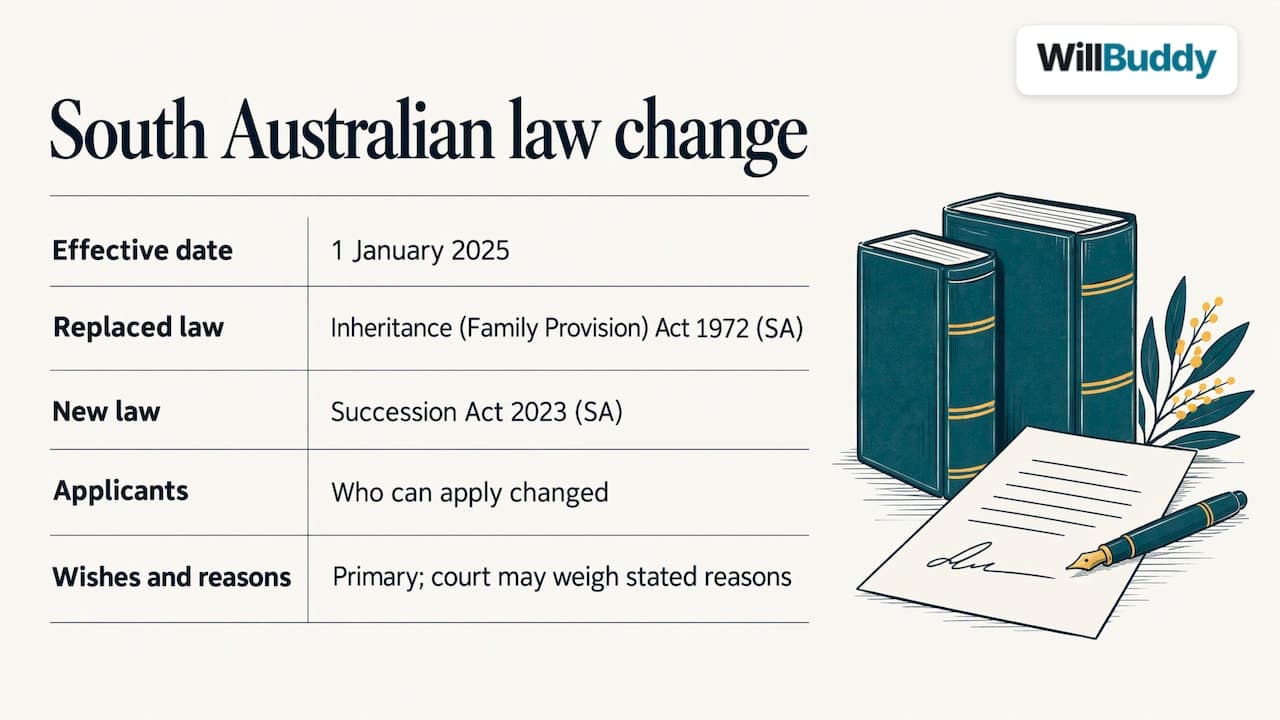
If you live in South Australia, this makes it more useful to record your reasons clearly while you are alive.
Does a no-contest clause work?
Many people have heard that you can add a clause saying anyone who challenges the will loses their gift. It sounds neat. It is not a dependable fix when you are leaving the child nothing.
One obvious problem: a child who receives nothing has nothing to lose by challenging. The clause has no bite.
The second problem is legal. An estate lawyer quoted in the Law Society Journal says these clauses are legally binding but can often be void as contrary to public policy, because they ask a person to give up a legal right.
The same article notes that inflammatory wording in a will can itself prompt a claim. So the will is the wrong place for an angry paragraph about the child.
How to record your reasons
A better approach is to keep the will short and factual, and record your reasons somewhere else.
The lawyer in that same Law Society Journal piece suggests a separate signed statement of reasons, worded objectively, held by the executors and disclosed only if needed to defend a claim. That is a sensible model. Here is how to use it.
- Write it separately from the will. The will stays clean. The statement is kept with your executor or your papers.
- Stick to facts. Say what happened and when. For example, how long you have been out of contact, or what support you gave in the past.
- Leave out insults and opinions. A calm tone reads better to a court.
- Mention what you considered. If you thought about the child's needs and the size of your estate, say so.
- Sign and date it. Review it when your situation changes.
Some reasons rest on events you may later need to show. If so, keep any records that support them, such as letters, emails or dates, with the statement.
You should also know the limits. A statement of reasons helps the court understand your thinking. It does not guarantee the court will agree. In South Australia, where your wishes have been the court's primary consideration since 2025, it may carry extra weight.
Choices that lower the risk of a successful claim
You cannot make a claim impossible. You can make it harder to win.
- Make a valid will. In general, a will must be in writing, signed by you, and witnessed by two people present at the same time (in Queensland, s 10 of the Succession Act 1981 (Qld)). Legal Aid NSW adds that you generally need to be 18 or older and have capacity, and that witnesses should not be beneficiaries.
- Name the child. Leaving a child out by silence can look like a mistake. A will that names the child and shows you meant it is clearer.
- Think about a smaller gift. Some parents give a modest amount instead of nothing. Whether that suits you depends on the child's circumstances and your estate. A lawyer can advise on that.
- Keep your estate in order. Your estate can include your home, land, car, bank money, shares, insurance policies and personal belongings. Know what you own. In most states a claim reaches only your estate, but in NSW the court can also treat some property outside it, such as jointly owned property or super, as "notional estate" (Succession Act 2006 (NSW), Part 3.3).
- Look at who else you support. Courts weigh competing claims, so a partner or a dependent child may affect how much is available.
For a closer look at grounds and deadlines, read our guide on whether a will can be contested in Australia.
When to see a lawyer
A simple will can be drafted online. Some situations call for a lawyer first. See one if:
- you are in a blended family (stepchildren, children from earlier relationships)
- you own a business or use a trust
- you have assets overseas
- you expect that someone will contest the will
These are the situations where a claim is most likely, and where mistakes cost the most. A lawyer can also advise on your own state's rules for your own facts.
Keep your will up to date
A will stays in force until you formally change or revoke it. According to the State Library of NSW legal guide, changed circumstances do not change it, apart from marriage (which usually revokes it) and divorce (which usually cancels gifts to a former spouse). Crossing out lines or writing in new clauses after signing generally has no effect unless the change is itself signed and witnessed (Succession Act 2006 (NSW) ss 12 to 14). Other states and territories have similar rules.
The Public Trustee of Queensland suggests reviewing your will after big life changes, such as marriage, separation, the birth of a child or grandchild, or the death of your executor or a beneficiary.
This matters if you exclude a child. A reconciliation, a new grandchild or a change in the child's health can all change what is fair. Your will should keep pace.
Guardians for your other children
If you have children under 18, the will is also where you name who will care for them. Moneysmart lists this among the things a will can cover. Talk to the person first. Our guide to minor children and guardianship in wills explains the steps.
Putting it in your will with WillBuddy
WillBuddy asks plain questions one at a time and drafts a will for your state or territory. You can name your executors, set out how your estate is shared, name guardians for children, and exclude individuals. You can read every word for free before you pay, then print it and sign it with witnesses.
If your life changes, the annual plan ($39 a year) gives you up to 50 AI-assisted edits a year, and your will is stored securely in Australia while your plan is active. WillBuddy encrypts your data and does not sell it. You can see the plan on the pricing page.

If you live in South Australia or Western Australia, there are free state guides too: the SA will guide and the WA will guide.
FAQ
Can I leave my child nothing in my will?
Yes. You can name them and give them nothing. They may still apply to the Supreme Court for provision, and the court will look at their needs, your estate and your reasons. A valid will and a calm record of your reasons put you in the strongest position.
Do I have to explain why I left a child out?
The law does not require it. A short, factual statement kept separately from the will can help your executors if a claim is made. Keep the tone neutral and leave out insults.
Does a no-contest clause stop a child from challenging?
Not reliably. A child who receives nothing has little to lose, and these clauses can be void as contrary to public policy. A separate statement of reasons is a more useful step.
How long does a child have to make a claim?
It depends on the state. In NSW it is 12 months from the date of death. In Victoria, WA and SA it is six months from the grant of probate or letters of administration. Courts can sometimes extend time, but not always.
Sources
Show the 15 sources
- Challenging an unfair will, Legal Aid WA (Family Provision Act 1972 (WA))
- Family provision claims, Legal Aid NSW
- Making a will, Legal Aid NSW
- Contested proceedings, Supreme Court of NSW
- Challenging a Will, Victoria Legal Aid
- Testator's family maintenance, LawHub
- Inadequate provision, SA Law Handbook (Succession Act 2023 (SA))
- Succession Act 1981 (Qld)
- Wills Week 2026, Public Trustee of Queensland
- Who can challenge my will?, Public Trustee Tasmania
- Family Provision Act 1969 (ACT)
- Family Provision Act 1970 (NT)
- Wills and powers of attorney, Moneysmart
- Changing or revoking a will, State Library of NSW
- Wills and succession: navigating complex family relationships, Law Society Journal
Start your will free at willbuddy.com.au and read it before you pay.
Recommended
For the one who gets things sorted
Now write yours, with your family's names in it
Plain questions about your family, one at a time, and WillBuddy drafts a will for your state. Until you sign one, the law in your state or territory decides who gets what. Read every word free, with no card. You pay only if you want to print it.
Start my will freeLast updated 24 November 2026.
This article is general information only and is not legal advice. It is our best interpretation of the law as at 24 November 2026. WillBuddy is not a law firm, and it never replaces advice from a lawyer or solicitor. Laws change and differ between states and territories, so for your own circumstances, please get legal advice.